 Miya Bholat
Jan 20, 2026
Minimum Tire Tread Depth: DOT Requirements for Steer, Drive, and Trailer Tires
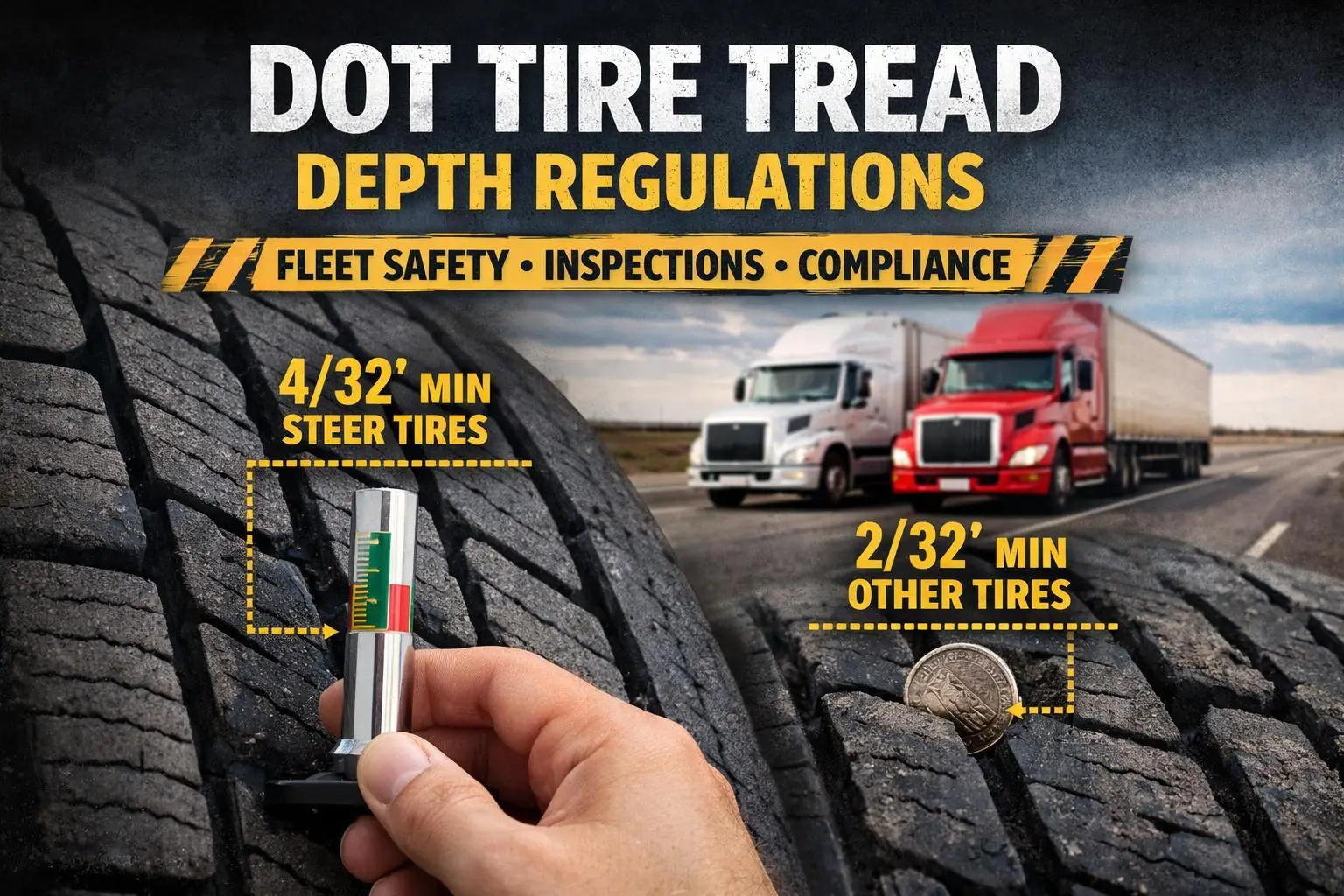
The minimum tire tread depth required by DOT under FMCSR §393.75 is 4/32 of an inch for steer tires and 2/32 of an inch for drive and trailer tires. Inspectors measure the shallowest major groove and not the average. There is no flexibility or grace period if a tire falls below the limit at any single point. For fleet managers, tire tread depth is not only one of the fastest ways trucks get flagged during DOT inspections and one of the easiest compliance risks to prevent. Yet many violations still come down to misunderstanding the actual regulations, checking the wrong tire position or simply waiting too long to replace worn tires.
This guide covers the exact DOT minimum requirements by tire position and why steer tires face stricter limits, how to measure tread depth accurately, what inspectors check during roadside reviews and how to build a tire inspection program that keeps fleets ahead of failures and violations. It also connects to the broader fleet safety and compliance framework that ties together driver, vehicle, and regulatory readiness.
Key Takeaways: Staying DOT Compliant with Tire Tread Depth
- Steer tires require 4/32", all others require 2/32".
DOT enforces different minimums based on tire position, and inspectors measure the shallowest major groove. - Tread depth directly impacts safety.
Stopping distance, hydroplaning resistance, and blowout risk all worsen as tread wears down. - Measurement accuracy matters.
Tread depth gauges, not visual checks, are the only reliable way to ensure compliance. -
Documentation protects your fleet.
Clear inspection records help resolve disputes and reduce inspection scrutiny. -
Replacing early often costs less.
Planned tire replacement prevents roadside failures, downtime, and CSA score damage. -
Structured inspection programs win.
Fleets that track inspections digitally and replace tires above minimums stay compliant and safer.
What Is the Minimum Tire Tread Depth Required by DOT?
The Department of Transportation sets minimum tire tread depth standards under FMCSR §393.75, and those standards vary depending on where the tire is mounted on the vehicle.
For most commercial vehicles operating under DOT rules, the legal minimums are:
- 4/32 of an inch on steer tires
- 2/32 of an inch on all other tires, including drive and trailer positions
That distinction matters. Steer tires play a critical role in directional control, braking, and wet-weather stability, which is why DOT holds them to a higher standard.
FMCSR §393.75 does not offer flexibility or grace periods. If a tire measures below the required depth at any major groove, the vehicle is considered non-compliant, regardless of how close it is to the limit or how recently the tire was installed.
Another important clarification: DOT inspectors measure tread depth where it matters most, not where it looks best. If a tire has uneven wear, cupping, or feathering, the shallowest major groove is what counts.
Why Tire Tread Depth Matters for Fleet Safety
Traction and Stopping Distance
Tread depth directly affects how much grip a tire can generate, especially during braking. According to industry testing, tires worn down to 2/32" can require up to 40% more stopping distance on wet pavement compared to tires at 6/32".
For a loaded truck traveling at highway speed, that difference can translate into dozens of additional feet before coming to a stop. That is often the margin between a close call and a collision.
Hydroplaning Risk
As tread depth decreases, a tire's ability to channel water away from the contact patch drops sharply. Research shows hydroplaning resistance declines rapidly once tread depth falls below 4/32", which is why steer tires face stricter DOT limits.
In fleet operations, hydroplaning incidents frequently occur during light rain, conditions drivers underestimate because roads appear only "damp," not flooded.
Blowout Prevention
While tread depth alone doesn't cause blowouts, worn tread often signals broader tire degradation. Low tread depth usually coincides with:
- Thinner rubber layers
- Increased heat buildup
- Greater exposure to road hazards
When tires fail at highway speeds, the result is often vehicle damage, cargo loss, roadside downtime, and DOT scrutiny, all of which are far more expensive than proactive replacement.
How to Measure Tire Tread Depth Accurately
The Penny Test vs. Professional Methods
Many drivers rely on the penny test because it's simple and familiar. While it can indicate whether a tire is obviously worn, it is not precise enough for DOT compliance.
The penny test cannot reliably distinguish between 2/32" and 4/32", and DOT inspectors do not accept it as proof of compliance. Fleets that rely on informal checks often miss borderline violations.
Using a Tread Depth Gauge
A tread depth gauge is inexpensive, fast, and accurate. To measure properly:
- Place the gauge into a major tread groove, not a wear bar
- Press firmly so the base sits flat on the tread
- Record the measurement in 32nds of an inch
- Repeat at multiple locations across the tire
This method provides objective data that holds up during inspections.
Where to Measure on the Tire
Tires rarely wear evenly, especially on commercial vehicles. To avoid surprises, inspections should always include:
- Inner and outer edges
- At least two major grooves
- Both tires on dual assemblies
DOT inspectors look for the lowest measurement, not the average. Fleets that only spot-check center tread often miss edge wear caused by alignment or suspension issues.
DOT Inspection Points: What Auditors Check
During a roadside inspection, tires are among the first components reviewed. Inspectors visually scan for bald spots, exposed cords, sidewall damage, and inflation issues before measuring tread depth.
If a tire fails to meet minimum requirements, the consequences can include:
- Immediate DOT violations
- Out-of-service orders if multiple tires are non-compliant
- CSA score impacts that affect audits, insurance rates, and shipper confidence
Certain conditions almost guarantee closer inspection. Uneven wear patterns, mismatched tread depths on duals, or poor inspection documentation often prompt inspectors to measure every tire on the vehicle.
Digital inspection records created through tools like AUTOsist's Digital Vehicle Inspection App help fleets demonstrate consistent inspection practices when compliance is questioned.
If a tire fails inspection and a violation is issued, understanding what happens when a DOT violation is issued helps fleets manage CSA score impact, fines, and contestable issues through the FMCSA system.
Most tire-related citations come up during a Level 3 DOT inspection, where officers verify documentation and observable vehicle safety items including tire condition.
Creating a Proactive Tire Inspection Program
Recommended Inspection Frequency
Strong tire programs rely on layered inspection schedules rather than occasional checks:
- Pre-trip inspections catch obvious defects before the vehicle moves
- Weekly inspections identify developing wear trends
- Monthly inspections support replacement planning and budgeting
This approach reduces roadside failures and spreads replacement costs more evenly throughout the year.
Documentation Requirements
DOT regulations expect fleets to prove inspections occurred — not just claim they did. Effective documentation includes:
- Date and mileage at inspection
- Tread depth measurements by position
- Inspector or driver identification
- Corrective actions taken
For a broader look at how tire compliance fits within the full DOT fleet maintenance requirements, this guide covers the maintenance standards inspectors actually look for during audits.
Using a centralized system like AUTOsist's Vehicle Service History System keeps tire data tied to each vehicle, making records easy to retrieve during audits.
Setting Replacement Thresholds Above Minimums
Many fleets replace tires well before legal minimums, commonly at:
- 6/32" on steer tires
- 4/32" on drive and trailer tires
This buffer reduces inspection risk, improves wet-weather safety, and allows replacements to be scheduled during planned maintenance instead of emergency downtime.
Tire Tread Depth by Position: Different Rules for Different Wheels
Quick Reference: Minimum Tread Depth by Tire Position
DOT minimum tread depth standards vary by tire position based on the role each tire plays in vehicle safety. The table below summarizes the current FMCSR §393.75 minimums alongside the replacement thresholds most well-managed fleets adopt to stay safely above the regulatory floor.
| Tire Position | DOT Minimum (FMCSR §393.75) | Why the Standard Is Set Here | Recommended Fleet Replacement Threshold |
|---|---|---|---|
| Steer Tires | 4/32" | Critical for directional control, wet braking, and hydroplaning resistance | 6/32" |
| Drive Tires | 2/32" | Power transmission with redundancy from paired duals | 4/32" |
| Trailer Tires | 2/32" | Load support with redundancy from multiple axles | 4/32" |
DOT regulations recognize that not all tires perform the same function. Steer tires guide the vehicle, drive tires transmit power, and trailer tires support load stability.
Steer tires carry higher minimums because failure or loss of traction has immediate safety consequences. Drive and trailer tires tolerate lower tread depths but still pose risks when run to the limit.
Dual tire assemblies introduce another concern. When tread depths differ significantly between paired tires, load distribution becomes uneven, increasing heat buildup and wear. While DOT does not specify a maximum allowable difference, inspectors may cite unsafe conditions if mismatches appear excessive.
Tracking tread depth by position inside a fleet maintenance platform like AUTOsist's Fleet Reports and Dashboard helps managers spot inconsistencies before they become violations.
Cost vs. Compliance: When to Replace Commercial Tires
At first glance, squeezing every last mile from a tire seems cost-effective. In reality, running tires to the legal minimum often increases total cost.
Consider a simplified example. A steer tire costing $600 that fails prematurely can easily trigger:
- A $300 roadside service call
- Lost driver hours
- Delayed deliveries
- CSA score impacts that raise insurance premiums
Compared to planned replacement during scheduled maintenance, the "savings" disappear quickly.
Proactive replacement also improves fuel efficiency, reduces suspension stress, and lowers accident risk. Fleets that manage tire life through structured maintenance systems consistently see lower total cost of ownership than fleets that react to failures.
A structured fleet compliance approach reduces tire-related citations by integrating inspection cadence, replacement thresholds, and audit-ready documentation into a single workflow.
AUTOsist supports this approach by tying tire inspections to Fleet Preventive Maintenance Schedules and Reminders, helping fleets replace tires before compliance issues or failures occur.
Frequently Asked Questions
-
What is the minimum tire tread depth required by DOT?
The minimum tire tread depth required by DOT under FMCSR §393.75 is 4/32 of an inch for steer tires and 2/32 of an inch for drive and trailer tires. Inspectors measure the shallowest major groove, not the average across the tire. If a tire falls below the minimum at any single major groove, the vehicle is considered non-compliant regardless of how the rest of the tire looks. -
What is the minimum tread depth for steer tires?
The DOT minimum tread depth for steer tires is 4/32 of an inch (FMCSR §393.75). Steer tires face a higher minimum than other tire positions because they directly control steering, braking, and wet-weather stability. Most well-managed fleets replace steer tires at 6/32 of an inch to maintain a safety buffer above the legal minimum and reduce the risk of hydroplaning and inspection violations. -
What is the minimum tread depth for drive and trailer tires?
The DOT minimum tread depth for drive tires and trailer tires is 2/32 of an inch (FMCSR §393.75). These positions tolerate lower minimums because power transmission and load support are distributed across multiple tires, providing redundancy that steer tires do not have. Many fleets still replace drive and trailer tires at 4/32 of an inch to avoid roadside failures and CSA score impact. -
What is the difference between steer, drive, and trailer tire tread depth requirements?
Steer tires require a minimum of 4/32 of an inch under DOT regulations, while drive and trailer tires require a minimum of 2/32 of an inch. The difference reflects the safety role of each tire position. Steer tires control directional stability and braking, so loss of grip has immediate consequences. Drive and trailer tires share load and traction across multiple tires, allowing DOT to set a lower minimum while still maintaining safety margins. -
How do you measure tire tread depth accurately for DOT compliance?
To measure tire tread depth accurately for DOT compliance, use a tread depth gauge rather than the penny test. Place the gauge into a major tread groove (not a wear bar), press firmly so the base sits flat, and record the reading in 32nds of an inch. Repeat at multiple points across the tire, including inner and outer edges and at least two major grooves, since tires rarely wear evenly. DOT inspectors look for the lowest single measurement, not the average. The penny test cannot reliably distinguish between 2/32 and 4/32 of an inch and is not accepted as proof of compliance during inspections.