 Miya Bholat
Mar 20, 2026
8 Fleet Optimization Metrics You Should Be Tracking Right Now
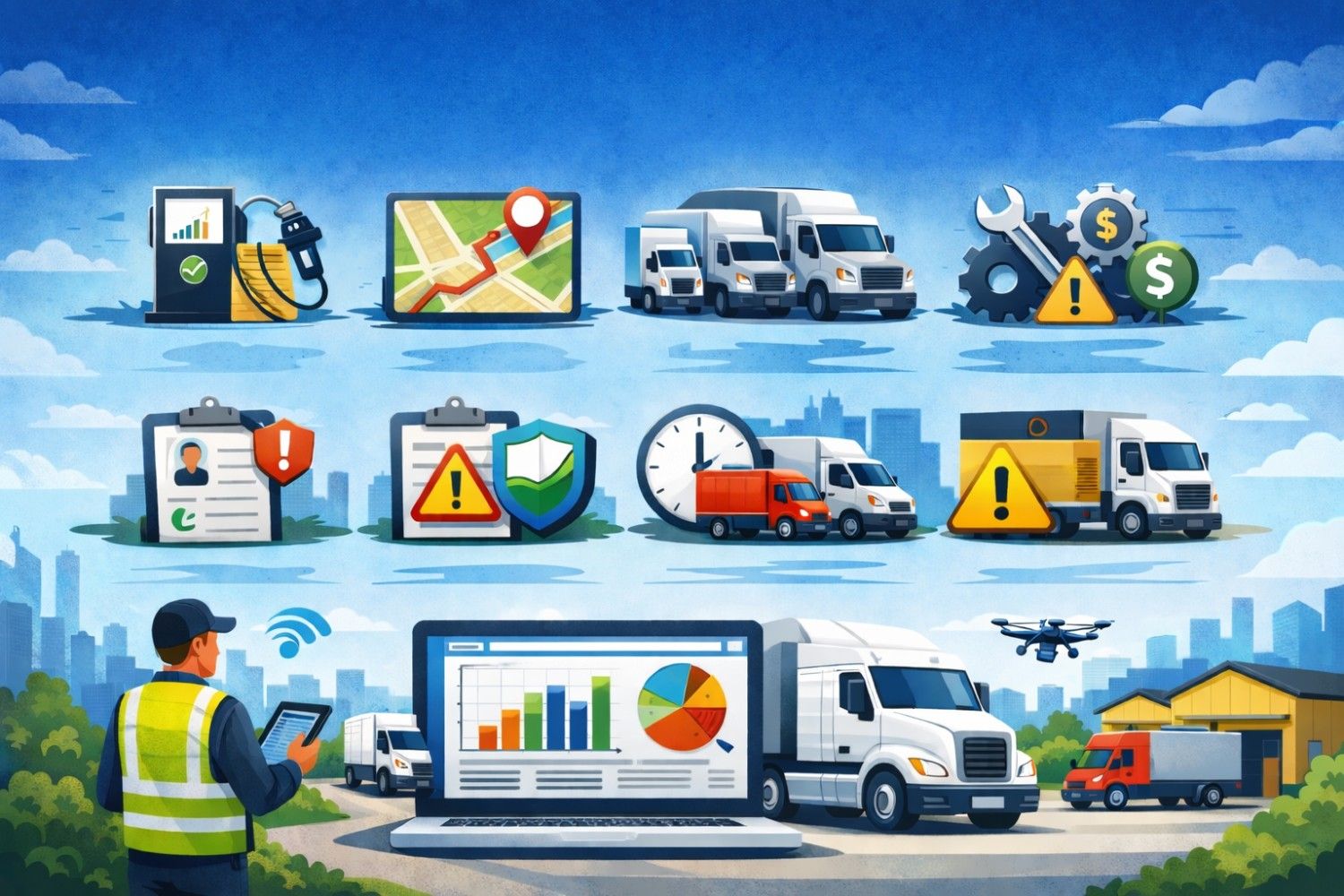
Key Takeaways
- TCO reveals the true cost of your fleet — Track beyond fuel and repairs to understand full lifecycle expenses and make smarter replacement decisions.
- Utilization exposes hidden inefficiencies — Underused vehicles quietly drain resources and reduce ROI.
- Preventive maintenance compliance prevents bigger problems — Skipping scheduled maintenance leads to exponential repair and downtime costs.
- MTBF highlights reliability trends — A declining MTBF signals deeper issues with vehicle health or maintenance practices.
- Fuel cost per mile identifies inefficiencies fast — Small behavioral or routing changes can significantly impact overall costs.
- Downtime is a direct productivity killer — Reducing unscheduled downtime should be a top operational priority.
- Cost per mile simplifies decision-making — It's the most effective single metric for comparing vehicles and operations.
- Driver behaviour impacts everything — Fuel, maintenance, and safety all improve when driver performance is tracked and coached effectively.
If You're Not Measuring It, You Can't Manage It
Most fleet managers don't struggle with effort — they struggle with visibility.
You're constantly reacting: a breakdown here, fuel costs creeping up there, drivers missing service intervals. It feels like putting out fires instead of preventing them. And the root cause is almost always the same — a lack of clear, consistent metrics.
Without the right data, decisions become guesswork. You might feel like costs are rising or efficiency is dropping, but you can't pinpoint why or fix it systematically.
The difference between reactive fleets and optimized fleets comes down to one thing: tracking the right metrics consistently.
The following eight metrics give you a complete, practical view of cost, efficiency, reliability, and performance — the foundation of any well-run fleet.
1. Total Cost of Ownership (TCO) Per Vehicle
Most fleets underestimate what their vehicles actually cost.
They track fuel and maybe maintenance — but ignore the full lifecycle cost. That's where Total Cost of Ownership (TCO) becomes critical.
TCO includes everything tied to a vehicle over its lifespan:
- Purchase or lease cost
- Fuel expenses
- Preventive and corrective maintenance
- Insurance and registration
- Depreciation
- End-of-life disposal or resale
How to Calculate TCO
A simple way to calculate TCO is:
TCO = Total lifetime costs ÷ Total miles driven
For example, if a truck costs ₹25,00,000 over its lifetime and runs 2,50,000 km, your TCO is ₹10 per km.
This number becomes incredibly powerful when comparing vehicles or identifying outliers.
What a High TCO Is Telling You
When TCO rises, it's usually a signal — not just a number.
Common causes include:
- Aging vehicles requiring frequent repairs
- Poor preventive maintenance compliance
- Inefficient fuel usage
- Vehicles being kept past optimal replacement time
Tracking TCO helps you move from reactive spending to strategic lifecycle planning.
2. Vehicle Utilization Rate
Vehicle utilization tells you how much of your fleet is actually being used.
It compares actual usage vs. available capacity, helping you identify underused assets.
Utilization Rate = (Active usage time ÷ Available time) × 100
For example, if a vehicle is used 6 hours in a 10-hour available window, utilization is 60%.
Underutilized vehicles are expensive — even when they're parked.
They still:
- Depreciate over time
- Require insurance coverage
- Need maintenance and inspections
- Occupy capital that could be deployed elsewhere
A healthy utilization rate typically falls between 70%–85%, depending on your operation.
Anything significantly lower may indicate overcapacity or poor scheduling.
3. Preventive Maintenance Compliance Rate
This is one of the most important metrics in fleet management.
It measures how consistently your fleet completes scheduled maintenance on time.
PM Compliance Rate = (Completed PM tasks on time ÷ Total scheduled PM tasks) × 100
A fleet with high compliance avoids breakdowns. A fleet with low compliance pays for it — in repairs, downtime, and lost productivity.
Why Skipped PMs Are More Expensive Than They Look
Skipping a simple oil change or inspection doesn't save money — it delays costs and multiplies them.
Low compliance often leads to:
- Increased breakdown frequency
- Shortened vehicle lifespan
- Higher emergency repair costs
- More unplanned downtime
Many fleets try to track PM schedules manually, but spreadsheets quickly become unreliable as fleets grow.
That's why tools like preventive maintenance scheduling are critical — they automate reminders, track completion, and eliminate missed service intervals.
4. Mean Time Between Failures (MTBF)
MTBF measures how long a vehicle operates before experiencing a failure.
It's a key indicator of reliability and overall fleet health.
MTBF = Total operating time ÷ Number of failures
For example, if a vehicle runs 1,000 hours and experiences 5 breakdowns, MTBF is 200 hours.
A declining MTBF is a warning sign.
It typically indicates:
- Aging equipment
- Deferred maintenance
- Poor repair quality
- Increasing operational stress
Fleets use MTBF to decide whether to continue repairing a vehicle or replace it entirely.
5. Fuel Cost Per Mile
Fuel is often the largest operating expense in a fleet.
Tracking fuel cost per mile gives you a clear, normalized way to measure efficiency.
Fuel Cost Per Mile = Total fuel cost ÷ Total miles driven
For example, ₹1,00,000 in fuel over 10,000 km equals ₹10 per km.
Benchmarking Your Fuel Efficiency
Fuel efficiency varies by fleet type, but benchmarking helps identify outliers.
If most vehicles average ₹8/km and one sits at ₹12/km, you've found a problem worth investigating.
The Role of Driver Behavior in Fuel Costs
Fuel consumption isn't just about vehicles — it's heavily influenced by drivers.
Key factors that increase fuel cost include:
- Excessive idling
- Aggressive acceleration
- Harsh braking
- Poor route selection
- Overloaded vehicles
Tracking fuel per vehicle — not just fleet-wide — helps isolate these issues quickly.
You can also pair this with fleet fuel tracking to monitor trends and detect inefficiencies in real time.
6. Downtime Per Vehicle
Downtime measures how long vehicles are unavailable for operation.
It includes both:
- Scheduled downtime (maintenance, inspections)
- Unscheduled downtime (breakdowns, unexpected repairs)
You can track downtime in hours or days per vehicle per month.
High downtime directly impacts:
- Delivery schedules
- Customer satisfaction
- Revenue generation
- Fleet productivity
Unscheduled downtime is especially costly — and often tied to poor maintenance practices.
If downtime is rising, it's usually connected to declining PM compliance or aging assets.
7. Cost Per Mile (Overall Operating Cost)
While fuel cost per mile is important, it only tells part of the story.
Cost per mile captures total operating cost, including:
- Fuel
- Maintenance
- Tires
- Insurance
- Repairs
- Depreciation
Cost Per Mile = Total operating cost ÷ Total miles driven
This metric gives you a single, powerful number to compare:
- Vehicles
- Routes
- Time periods
- Driver performance
It's one of the most effective ways to justify vehicle replacement decisions.
If an older vehicle consistently costs more per mile than a newer one, the data makes the decision clear.
8. Driver Behavior Score
Modern fleets don't just track vehicles — they track drivers.
A driver behavior score combines multiple inputs into a single performance metric.
Typical behaviors tracked include:
- Speeding incidents
- Harsh braking
- Rapid acceleration
- Idling time
- Sharp cornering
These behaviors have a direct impact on:
- Fuel consumption
- Maintenance costs
- Accident risk
- Vehicle wear and tear
Turning Behavior Data Into Coaching Opportunities
The goal isn't to penalize drivers — it's to improve performance.
Fleets that use behavior data effectively:
- Identify high-risk driving patterns early
- Provide targeted coaching
- Reward safe driving habits
- Reduce accidents and associated costs
This is where fleet reporting and analytics becomes essential — turning raw data into actionable insights.
How to Start Tracking These Metrics Without Drowning in Spreadsheets
Tracking all of these metrics manually sounds good in theory — but in practice, it breaks down quickly.
Spreadsheets become outdated. Data gets missed. Reporting becomes inconsistent.
A proper fleet management system should:
- Centralize all vehicle, driver, and maintenance data
- Automate preventive maintenance scheduling
- Track fuel, costs, and usage in real time
- Generate reports without manual effort
- Highlight trends and anomalies automatically
This is where platforms like AUTOsist come in.
Instead of stitching together spreadsheets and manual logs, AUTOsist provides a single system to track maintenance, fuel, inspections, and performance — making these metrics visible and actionable without added workload.