 Miya Bholat
Mar 01, 2023
Fleet Driver Safety Program: How to Build One That Reduces Accidents, Liability, and Insurance Costs
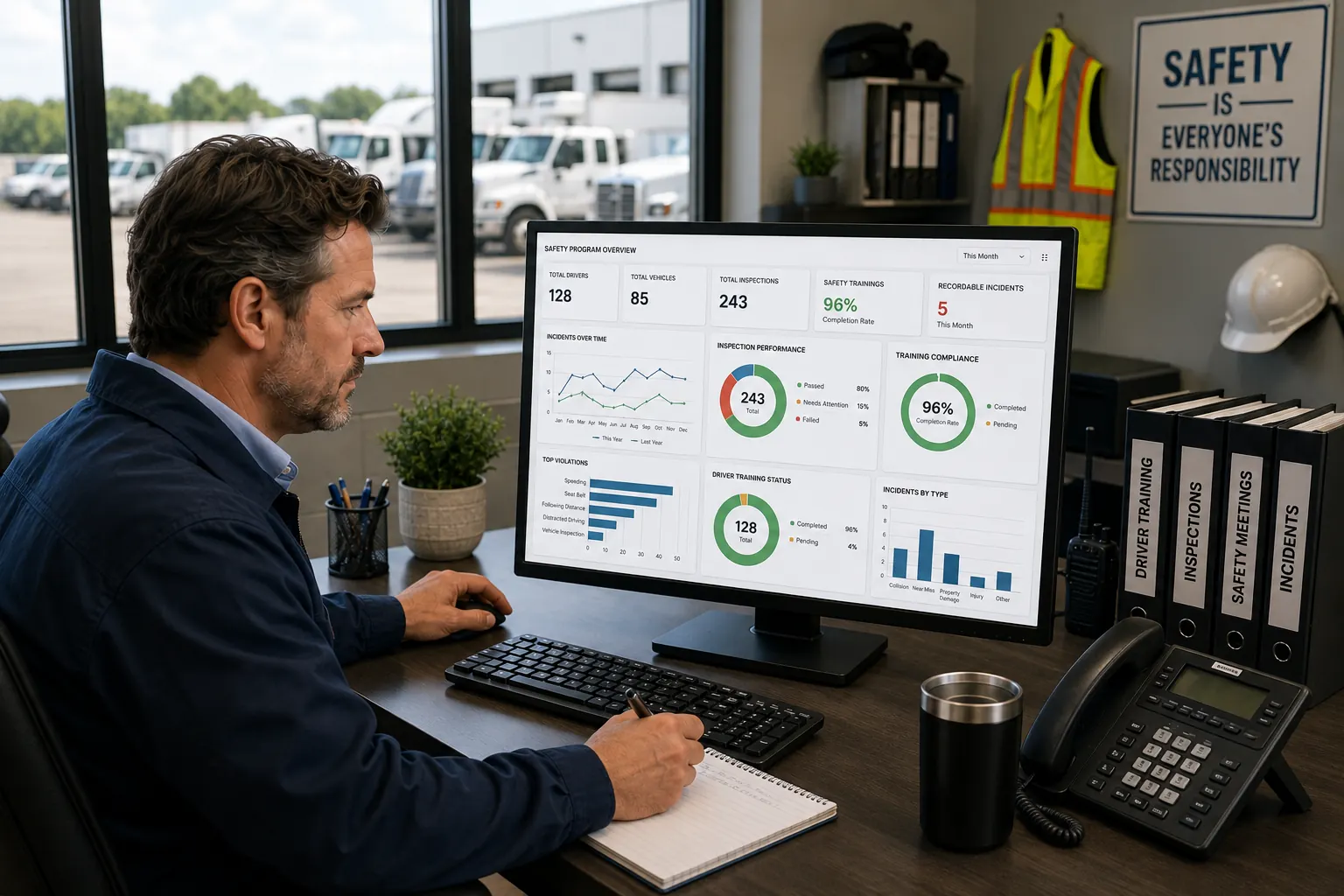
A fleet driver safety program is a structured set of policies, training, and operational practices that fleets use to reduce accidents, control insurance costs, and protect drivers on the road. For fleet managers, building one is no longer optional. Commercial vehicle incidents cost an average of $16,000 to $75,000 per minor accident, and serious incidents involving injury can push costs into the hundreds of thousands.
This guide walks through what a fleet driver safety program includes, the benefits it delivers, the seven components every program needs, and how to roll one out across a small-to-mid fleet without enterprise-level overhead. It also covers special considerations for government and public-sector fleets where compliance and audit pressure are higher. For fleets looking at the broader picture, this connects directly to a complete fleet safety and compliance framework that ties together driver, vehicle, and regulatory readiness.
Key Takeaways
- A Fleet Driver Safety Program Combines Multiple Operational Layers. It connects written policy, driver screening, training, behavior monitoring, and incident response into one continuous operational process.
- Accident Costs Hit Far Beyond the Repair Bill. Indirect costs like insurance hikes, downtime, recruiting, and lost contracts often exceed direct costs by two to four times.
- The Seven Essential Components Build on Each Other. Skipping any one component leaves a gap that the others cannot fully cover.
- Telematics and Dash Cams Make Behavior Monitoring Actionable. Objective data replaces driver self-reporting and supervisor guesswork, which is what makes coaching effective.
- Different Program Approaches Suit Different Fleets. Policy-led, technology-led, and hybrid approaches each carry distinct cost, complexity, and outcome trade-offs.
- Government and Public-Sector Fleets Operate Under Stricter Compliance Pressure. Audit readiness, OSHA standards, and procurement requirements add layers to standard fleet safety programs.
What Is a Fleet Driver Safety Program?
A fleet driver safety program is the documented combination of policies, training, technology, and procedures a fleet uses to prevent vehicle accidents, reduce liability exposure, and improve driver performance over time. It is not a single document or a one-time training course. It is a continuous operational process that connects how drivers are hired, trained, monitored, coached, and held accountable.
A complete program typically includes seven elements:
- A written safety policy
- Driver screening and qualification standards
- Ongoing training and education
- Vehicle inspection and preventive maintenance routines
- Driver behavior monitoring through telematics and dash cameras
- Performance tracking and recognition systems
- Incident reporting and root cause analysis
The strength of the program comes from how these elements connect. A written policy without monitoring becomes unenforceable. Monitoring without coaching becomes punitive. Coaching without consistent documentation becomes legally vulnerable.
Fleets that operate all seven components together consistently see lower accident rates, lower insurance premiums, and stronger audit posture than fleets running individual safety initiatives in isolation.
Benefits of a Fleet Driver Safety Program
Fleet driver safety programs deliver measurable benefits across five operational areas. These benefits compound over time as data, coaching, and policy enforcement reinforce each other.
Reduced Accident Frequency
Documented safety programs typically reduce at-fault accidents by 20 to 40 percent within the first 18 months of consistent implementation. The largest gains come from telematics-based coaching tied to clear policy enforcement.
Lower Insurance Premiums
Insurance carriers underwrite commercial fleets based on loss history, safety record, and documented safety practices. Fleets with a structured program in place qualify for lower premiums, higher coverage limits, and stronger renewal terms.
Improved Audit and Regulatory Readiness
A documented program supports DOT compliance reviews, OSHA inspections, and insurance audits. Centralized records on driver qualifications, training, vehicle inspections, and incidents are exportable on demand instead of assembled reactively.
Better Driver Retention and Morale
Drivers stay longer at fleets that invest in their safety. Clear policies, fair enforcement, and recognition programs signal that leadership takes safety as seriously as productivity.
Stronger Contract and Bidding Position
For fleets bidding on government, commercial, or municipal contracts, a documented safety program is increasingly a requirement, not a bonus. Procurement teams ask for safety records and program documentation as part of vendor qualification.
7 Essential Components of a Fleet Driver Safety Program
The strongest fleet driver safety programs are built from seven interlocking components. Each one strengthens the others, and gaps in one component create blind spots that ripple across the program.
Component 1: Written Safety Policy
A written safety policy is the foundation of every fleet driver safety program. It defines the rules, the expectations, and the consequences associated with unsafe behavior.
A comprehensive policy should clearly cover:
- Speeding and distracted driving rules
- Phone and electronic device use
- Seatbelt compliance
- Accident and near-miss reporting procedures
- Drug and alcohol policies
- Vehicle inspection requirements
- Disciplinary escalation procedures
Policies must be specific enough to enforce. Vague language like "drivers should follow safe driving practices" creates loopholes that erode the program over time. The policy should be reviewed annually and updated to reflect changes in regulation, technology, or fleet operations.
For fleets building the policy from scratch, structured frameworks like the fleet safety program reference guide outline how each policy category fits together.
Component 2: Driver Screening and Qualification
Hiring the wrong driver is one of the most expensive safety mistakes a fleet can make.
Effective screening covers:
- Motor Vehicle Record (MVR) checks
- CDL verification and endorsement validation
- Employment history review
- Drug and alcohol testing in line with FMCSA requirements
- Background screening
Most fleets repeat MVR checks annually to catch new violations. High-risk industries often rescreen every six months. Drivers with recent DUI history, repeated speeding violations, or excessive at-fault accidents should be flagged through the disqualification standards established in Component 1.
The cost of strong screening is small compared to the cost of an at-fault crash involving an unqualified driver.
Component 3: Ongoing Training and Education
Driver training cannot be a one-time event. Even experienced drivers benefit from refresher sessions that reinforce safe habits and update them on regulatory changes.
Effective training programs include:
- Defensive driving courses during onboarding
- Quarterly or semiannual safety refresher sessions
- Compliance training covering DOT, FMCSA, or OSHA requirements where applicable
- Scenario-based safety exercises
- Incident review and lessons-learned sessions
Training should be reinforced rather than treated as a checkbox. Drivers retain more from short, frequent reinforcement than from a single annual session.
While OSHA fleet safety guidelines provide a useful regulatory baseline, training should be specific to fleet operations and reinforced regularly.
Component 4: Vehicle Inspection and Preventive Maintenance
Mechanical failure causes thousands of commercial vehicle crashes each year. Brake issues, tire blowouts, and steering defects are largely preventable when fleets maintain disciplined inspection and maintenance routines.
A complete inspection and maintenance routine includes:
- Daily pre-trip and post-trip driver inspections
- Scheduled service intervals based on OEM recommendations
- Documented brake, tire, and steering checks
- Routine fluid and electrical system inspections
- Digital service history records
Manual paper logs and spreadsheets break down quickly as fleets grow. Tools like fleet preventive maintenance schedules and digital vehicle inspection apps automate reminders, log inspection results in real time, and flag overdue work before it becomes a failure.
Component 5: Driver Behavior Monitoring with Telematics and Dash Cams
Telematics and dash cameras transform safety programs from reactive to proactive.
Modern telematics systems track:
- Speeding events
- Hard braking and rapid acceleration
- Harsh cornering
- Excessive idling
- Seatbelt use
Dash cameras add visual context that becomes critical in disputed incidents and insurance claims. Together, telematics and dash cams give fleet managers objective data that replaces driver self-reporting and supervisor guesswork.
The key is how the data is used. Punitive monitoring creates resentment. Coaching-based monitoring built around fleet driver safety cameras and behavior scoring creates measurable improvement.
For fleets going deeper on this approach, a complete guide to fleet driver monitoring covers the metrics, scorecards, and review cadences that turn telematics data into real behavior change.
Component 6: Safe Driver Scorecards and Recognition
Recognition is the lever that turns monitoring data into long-term behavior change.
Effective recognition programs include:
- Driver scorecards based on objective behavior data
- Monthly or quarterly safe-driver awards
- Performance-based bonuses or incentives
- Public recognition in team meetings
- Visible leaderboards drivers can track
Drivers respond better to recognition than to surveillance. When safe driving is tied to tangible rewards, the program becomes self-reinforcing. Structured driver behavior monitoring frameworks help managers translate raw telematics events into fair, scorecard-ready metrics.
Component 7: Incident Reporting and Root Cause Analysis
Accidents and near-misses are inevitable. What separates strong programs from weak ones is how they respond.
Effective incident response includes:
- Immediate medical and emergency response procedures
- Scene documentation with photos and driver statements
- Preservation of telematics and dash cam data
- Insurance and regulatory reporting where required
- Root cause analysis after every incident
Near-miss reporting is just as important as accident reporting. Most serious incidents are preceded by smaller warning events that could have been addressed earlier.
For fleets operating under DOT regulations, knowing what happens when a DOT violation is issued helps shape both the immediate incident response and longer-term corrective action.
Pros and Cons of Different Fleet Safety Program Approaches
Fleets typically build their safety program around one of three dominant approaches. Each carries different cost, complexity, and outcome trade-offs.
| Approach | Strengths | Limitations | Best For |
|---|---|---|---|
| Policy-Led | Low upfront cost, easy to document, supports audits | Limited visibility into driver behavior, slow to detect issues | Fleets under 15 vehicles, low risk exposure |
| Technology-Led | Real-time visibility, objective data, fast incident detection | Higher upfront cost, requires data review discipline | Fleets with high mileage, high-risk routes, or insurance pressure |
| Hybrid (Policy + Technology) | Best long-term outcomes, supports both prevention and defense | Highest implementation effort, requires coordinated rollout | Most small-to-mid fleets above 20 vehicles |
Most fleets eventually move to the hybrid approach. The policy-only approach struggles to keep up as fleets grow, and the technology-only approach fails when behavior data has no policy framework to enforce it against. The hybrid approach combines the documentation strength of policy with the visibility and accountability of technology.
How to Roll Out a Fleet Driver Safety Program: Step-by-Step
Implementing a fleet driver safety program is rarely an overnight project. Most small-to-mid fleets stage the rollout across three to six months in five phases.
Phase 1: Foundation (Weeks 1 to 4)
- Draft the written safety policy
- Define disciplinary tiers and consequences
- Establish driver screening standards
- Communicate the program to all drivers and managers
Phase 2: Training and Onboarding (Weeks 4 to 8)
- Roll out initial driver training
- Have drivers sign the safety policy acknowledgment
- Schedule the first round of refresher sessions
- Document everything centrally
Phase 3: Technology Layer (Weeks 6 to 12)
- Install telematics devices across the fleet
- Install dash cameras where applicable
- Configure driver scorecards and behavior thresholds
- Train managers on data review and coaching workflows
Phase 4: Coaching and Recognition (Weeks 10 to 16)
- Begin one-on-one coaching sessions based on telematics data
- Launch driver scorecards and leaderboards
- Establish recognition cadence and rewards
- Hold the first program review meeting
Phase 5: Continuous Improvement (Ongoing)
- Review program metrics quarterly
- Adjust policy and training based on incident trends
- Re-screen drivers annually
- Audit documentation for regulatory readiness
Fleets that follow a phased rollout report higher driver buy-in and stronger long-term outcomes than fleets that try to launch every component simultaneously. Pairing this approach with broader fleet safety best practices keeps the program aligned with the wider safety operations of the fleet.
Fleet Driver Safety Programs for Government and Public-Sector Fleets
Government and public-sector fleets operate under safety conditions that most commercial fleets do not face. Procurement standards, OSHA requirements, transparency obligations, and political accountability all raise the bar for what a fleet driver safety program needs to deliver.
For fleet managers running government fleet management operations, the standard seven components still apply, but several elements need stronger documentation:
- Policy documentation must align with municipal, state, or federal procurement standards in addition to internal rules.
- Driver screening often includes background checks beyond MVR review, especially for emergency services, school transportation, or public works fleets.
- Training records must be retained longer and exported on demand for audit purposes.
- Incident reporting is subject to public records requirements in many jurisdictions, raising the documentation standard.
- Vehicle inspection routines must satisfy both internal policy and any applicable state-level public-sector vehicle inspection requirements.
Public-sector fleets that operate emergency vehicles (EMS, fire, police) carry additional safety considerations around emergency driving, code response, and equipment operation that go beyond standard road safety training.
The fundamentals of the program remain the same. What changes is the documentation rigor, the audit frequency, and the scope of compliance obligations layered on top.
How Fleet Software Supports a Driver Safety Program
Fleet management software ties the seven components of a driver safety program into a single operational system. Without it, fleets often run safety initiatives in isolation: training records in one folder, inspection logs in another, telematics data in a third dashboard, and incident reports stored in email.
Fleet software centralizes safety-related data across the fleet:
- Driver records and screening documentation
- Training history and certification tracking
- Vehicle inspection results and maintenance schedules
- Telematics behavior data
- Incident documentation and corrective actions
Tools that support fleet user and driver management often serve as the foundation. Layering in GPS fleet tracking and telematics extends the system into operational visibility. Together, these tools turn a paper-based safety program into a continuous, audit-ready operational process.
The right software supports the human work of policy, training, and coaching. It removes the friction and documentation overhead that causes most safety programs to lose momentum after the first year.
Frequently Asked Questions
-
What is a fleet driver safety program?
A fleet driver safety program is a structured combination of written policies, driver screening, training, telematics-based monitoring, and incident response procedures that fleets use to prevent accidents, reduce liability, and lower insurance costs. It is not a single document or training course. It is a continuous operational process that connects how drivers are hired, trained, monitored, coached, and held accountable. -
What are the benefits of a fleet driver safety program?
The main benefits are reduced accident frequency (typically 20 to 40 percent reduction within 18 months), lower insurance premiums, improved DOT and OSHA audit readiness, better driver retention, and stronger positioning when bidding for government or commercial contracts that require documented safety practices. -
How do I build a fleet driver safety program?
Build it in five phases over three to six months: draft the written safety policy, roll out driver training and onboarding, deploy telematics and dash cameras, launch coaching and recognition programs, and establish quarterly reviews for continuous improvement. Most small-to-mid fleets find a phased rollout drives better long-term outcomes than launching every component at once. -
What are the pros and cons of different fleet driver safety program approaches?
Policy-led programs are low-cost and easy to document but lack behavior visibility. Technology-led programs deliver real-time data but require disciplined review processes. Hybrid programs combining policy and technology deliver the strongest long-term outcomes but require the most implementation effort. Most fleets above 20 vehicles end up adopting the hybrid approach because policy-only programs struggle to scale and technology-only programs lack enforcement frameworks. -
What additional considerations apply to government and public-sector fleet safety programs?
Public-sector fleets face stricter audit requirements, longer record retention, public records obligations, procurement-aligned documentation standards, and in some cases additional state-level vehicle inspection requirements. Emergency vehicle fleets (EMS, fire, police) carry additional considerations around emergency driving, code response, and equipment operation. The seven core components still apply, but documentation rigor and audit frequency increase.